Material file 01/06 Zinc alloy · brass · electroplated
Metal buttons that survive the washnot just the lookbook.
Jean tacks, blazer fronts, coat buttons, bag hardware. 12–25 mm, shank or 2/4-hole, nine plating recipes including real gold flash, antique bronze and gunmetal — die-cast, polished, plated and salt-spray tested under one roof.
MOQ 1,000 pcs48 h salt sprayNickel-free optionFree tech-pack review
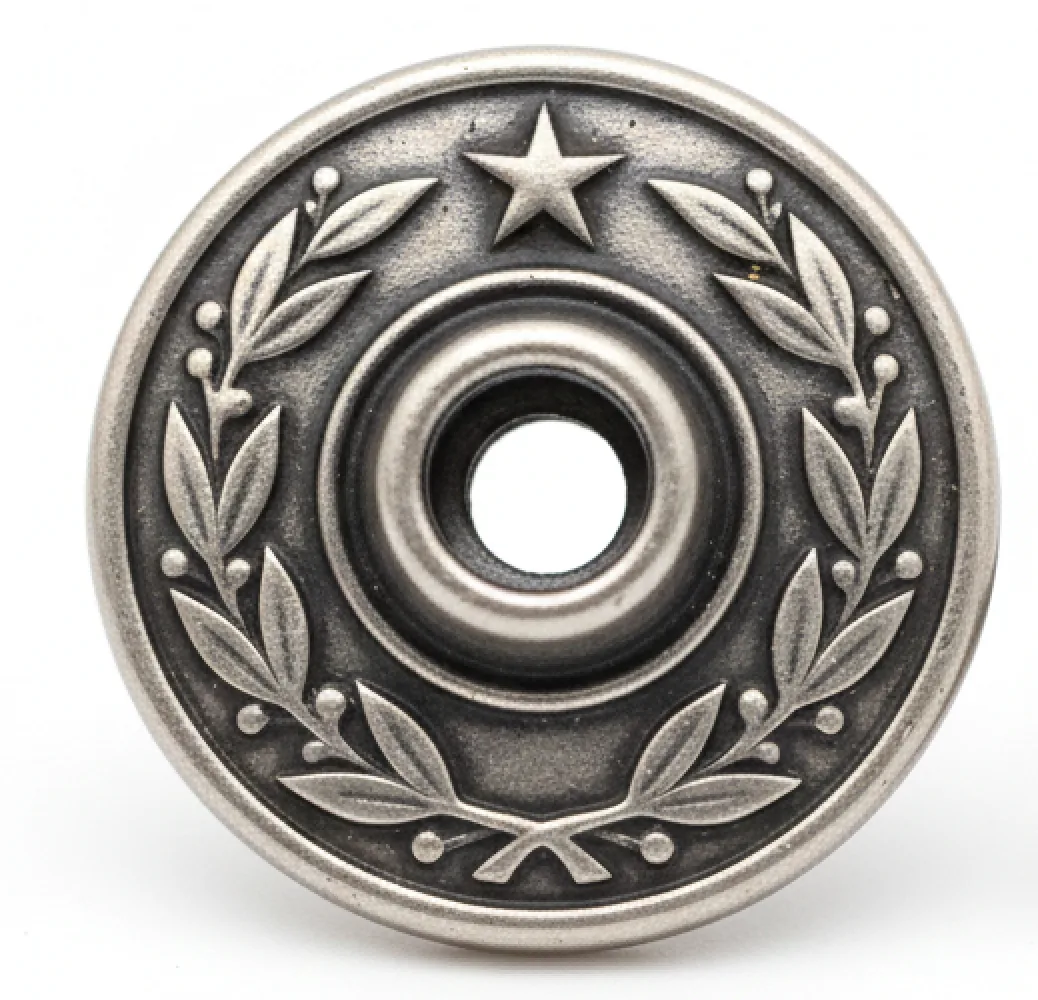
- Holes
- 4H / shank
- Size
- 18 mm
- Finish
- Antique bronze
- MOQ
- 1,000 pcs
- From
- $0.048 / 5k
02 The case for metal
The one button a buyer actually pulls on.
Every other trim hides behind a fold. The waistband button gets grabbed in every fitting room and twice a day for ten years. It is the cheapest part of the garment and the first thing that fails — which is why it should not be the part you save two cents on.
Salt spray, before it leaves
Neutral salt spray for 48 hours — the standard most European buyers quote. White rust that appears in week six of a shipping container shows up in our lab in two days instead.
Cross-hatch adhesion
Plating that flakes is worse than plating that tarnishes. Every lot gets a lattice cut and tape pull; below 4B the batch is stripped and re-plated, not shipped with a note.
Pull strength, 18 mm shank
Die-cast zinc with a rolled shank, not a pressed tin shell. Tested on a tension gauge — the button should bend before it lets go of the fabric.
03 Applications
Where metal earns its keep.
These are the sizes and hole patterns we ship most of. If your spec sheet says something different, send it — we quote to your sheet, not to our catalogue.
Denim & jeans
The waistband tack takes the highest load in the whole garment. We mould it in one piece with a rolled shank and test pull strength on every batch.
Jackets & blazers
Thin rim, low dome — a blazer button should not read as hardware. Bright silver and light gold are the two we ship most for tailoring.
Coats & trench
Wool needs a wider flange so the button does not sink into the cloth. Rimmed edge, 2.4 mm thick, with a shank option for heavy melton.
Workwear & uniforms
Industrial laundering is the test that kills plated buttons. If the garment is washed at 75 °C, say so at quoting and we specify a thicker nickel layer.
Heavy knit & cardigans
Shank buttons sit above the knit instead of crushing it. Round shank, no sharp edge on the underside — this is where cheap metal buttons snag yarn.
04 Finishes
Nine plating recipes, one die.
The die decides the shape; the plating line decides everything the buyer sees. Adders below are at 18 mm / 5,000 pcs and are percentages, so they scale with the button — a 25 mm takes more bath time than a 15 mm.
Bright silver
Nickel or palladium over copper strike. The default for tailoring.
baseBright gold
18K gold flash over nickel. Warm, not yellow-brass.
+18%Antique bronze
Darkened and relief-polished so the recesses stay dark. Denim standard.
+6%Gunmetal
Black-chrome look with a cool cast. Coats, bags, techwear.
+6%Black nickel
Deeper and flatter than gunmetal. Reads almost matte in daylight.
+8%Rose gold
Copper-rich flash. Popular on womenswear and resort.
+22%Brushed / satin
Directional grain before plating. Hides fingerprints.
+10%Hammered
Hand-hammered face, then plated. Every button slightly different.
+15%Distressed / washed
Tumbled after plating to break the shine at the edges.
+12%05 Size & shape
Millimetres first, Ligne in brackets.
Metal is bought by diameter, so that is how we quote it — the Ligne figure is there for the tech pack. Half the disputes we see start with two people converting the same number differently.
06 Process
Cast, polished, plated — five steps, no outside vendor.
Plating is where metal buttons go wrong, and it is the step most suppliers subcontract. Ours stays in the building, so a failed adhesion test is a line stop — not a phone call to a partner factory.
Die & alloy
Zinc alloy 3# or brass, depending on the load the button has to take. Your drawing becomes a two-plate die; the runner is designed so the shank fills last.
Die-casting
Hot-chamber casting at 420 °C. Wall thickness and shank geometry are set here — the two numbers that decide whether the button bends or breaks.
Deburr & polish
Vibratory deburr, then barrel polish. Buff level decides whether the final surface reads bright, satin or brushed.
Plate
Copper strike, nickel, then the top coat — gold, bronze, black or gunmetal. Rack plating for visible faces, barrel for shanks and rivets.
Test & pack
Salt spray, cross-hatch, pull test. AQL 2.5 visual. Packed in polybags by colour, cartons labelled to your barcode.
Nickel-free on request
EU nickel directive is the one requirement that changes the whole bath. Say it at quoting — retrofitting a nickel-free line mid-order is not a two-day job.
One die, six materials
Resin, ABS, corozo, coconut, horn and metal under one roof. One inspection, one container, one person chasing it.
Tooling credited back
Custom die from $180, half returned at 50,000 pcs. A new shape should not cost you a factory line to test.
07 Before you commit
Order 20,000 buttons blind? We would not either.
Plating is the one thing a photograph cannot tell you. Hold nine of them, in your own light, on your own fabric — then decide.
08 How to order
Draw it, approve it, receive it.
Metal has one extra step that resin does not: the die. It adds three days and, on a first order, the only real decision you have to make.
Send the drawing
A sketch with diameter, thickness, hole pattern and the load the button carries. A photo of a button you like works too — we reverse it into a drawing.
Die quote & plating call
Die cost, unit price and the plating spec in one sheet. Tell us the wash temperature and the market; both change the nickel layer.
Sample in 6 days
Cast, plated and photographed against a grey card. Approve the coupon, not the render.
Bulk & inspection
6–8 days at 5,000 pcs. AQL 2.5 with a photo report, packed by colour, shipped on your forwarder or ours.
Estimate
- Die-cast zinc alloy, not pressed shell
- Copper strike + nickel + top coat
- AQL 2.5 inspection with photo report
- Polybag, carton, labelled to your barcode
Indicative only — final price depends on drawing, tooling and packing. All six materials here.
09 FAQ
What buyers ask about metal.
The questions that decide whether a metal button survives a wash test — answered the way we would answer them on a call.
Will the plating come off in the wash?+
Not if the plating matches the wash. A domestic 40 °C wash with 20 cycles is a different spec from industrial laundering at 75 °C with bleach. Tell us the wash regime at quoting; we set nickel thickness to suit it. Standard domestic spec passes 20 cycles with no exposed base metal.
Is it nickel-free?+
We can supply nickel-free (palladium over copper) on request — it is a different bath, so it needs to be on the PO, not added later. EU 1907/2006 nickel release limit is 0.5 µg/cm²/week, tested to EN 1811.
Zinc alloy or brass?+
Zinc for anything up to about 90 N pull: cheaper, casts cleanly, plates well. Brass for heavy denim tacks and buttons that get hammered — it takes more load and holds a shank better. Both are quoted separately.
How much does the die cost?+
From $180 for a 2-plate die, $320 for a shank die with an insert. Half is credited back at 50,000 pcs. Die lead time is 5–7 days and it is yours — we do not reuse it for other buyers.
Can you match a Pantone colour?+
On painted and lacquered finishes, yes, to ΔE 1.5. On plated finishes no — plating colour comes from the metal, so we match against a physical coupon instead. Send us the reference button and we plate to it.
What about the shank breaking?+
A pressed shank is a folded sheet — it opens under load. Ours is cast in one piece with the body, then the shank is rolled. Pull tested at ≥ 90 N on an 18 mm; on a 17 mm denim tack we test to 120 N.
Minimum order?+
1,000 pcs per size and finish. Under that, the die amortisation dominates the price and the number stops being useful. Mixed finishes on one die are fine above 500 pcs each.
Lead time?+
6–8 working days at 5,000 pcs once the die is approved, 8–9 days at 10,000, 10–13 at 50,000. Die making adds 5–7 days on a first order. Sample is 6 days including plating.
Send the drawing.
We send back a die quote and a plating spec.
Diameter, thickness, hole pattern, wash temperature, market. That is enough to quote without a meeting.
Reply within 4 working hours · Ningbo, China · Factory-direct since 1996
— total
Reply within 4 h · MOQ 1,000 pcs · Ningbo, China