
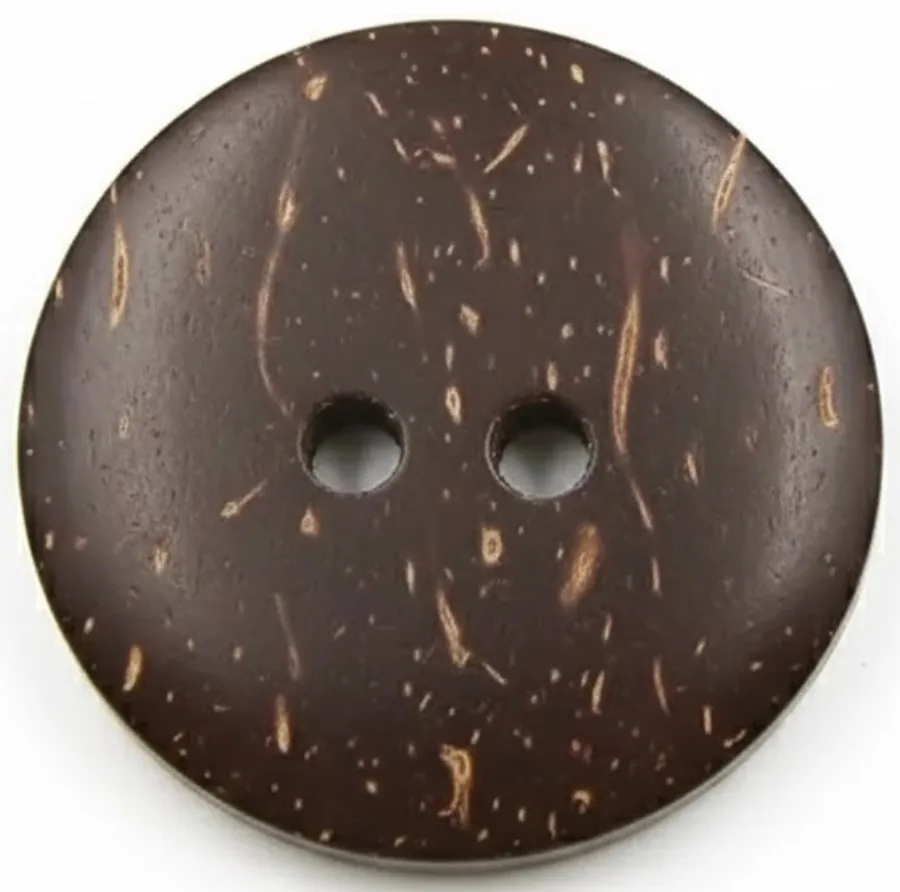
Material file 05/06 Coconut shell · hand-finished
Coconut shell, cut so the grainruns the way you want it.
Shirts, casual jackets, bags, resort wear. 15–28 mm, cut from shell, edge-turned and waxed. Every button is a different brown — that is the material, not a defect, and it is the reason people pay for it in the first place.
MOQ 1,000 pcsNo two alikeWaxed, water-resistantFree tech-pack review
- Holes
- 2H / 4H
- Size
- 20 mm
- Finish
- Natural wax
- MOQ
- 1,000 pcs
- From
- $0.038 / 5k
02 The case for coconut
The grain is the feature, not the flaw.
A coconut button is a piece of a shell with two holes in it. That is the entire product, and it is why it looks like nothing else on a garment: the pattern on the face was there before the tree fell. Photographs undersell it; buyers who touch it do not ask why it costs more than resin.
Millimetres, and that is the limit
A shell is not a block. Above 2.8 mm the disc starts to curl as it dries, so coconut stays a thin button — perfect for shirting and trims, wrong for a coat front that needs a fat rim.
Shell, and nothing else
No polymer, no plating, no printing. Waxed with a food-grade carnauba, which is what makes it shed water instead of drinking it.
Tolerance, stated honestly
Shell thickness varies across a single nut, so the disc is dimensionally looser than moulded plastic. On a shirt placket nobody notices; on a jig that feeds a machine, it matters and we will say so.
03 Applications
Where coconut belongs.
Warm, casual, outdoors-adjacent. It is the wrong button for a business shirt and the right one for almost everything sold with a linen look.
Casual shirts
The volume use. 2 mm disc keeps the placket flat, and the dark shell reads well against chambray, linen and washed poplin.
Casual jackets
Unlined cotton and linen jackets. A slightly domed face catches light around the rim without looking polished.
Shorts & resort trousers
Waistband needs thickness, so we cut this one from the thickest part of the shell and keep the rim turned rather than rounded.
Heavy knit & cardigans
Chunky knit wants a big, low-contrast button. Coconut next to oatmeal wool is the combination we ship most in autumn.
Bags & trims
Canvas and raffia bags. Engraving burns dark into the shell and never rubs off, unlike a printed logo.
04 Finishes
Waxed, dyed, engraved or left raw.
Coconut finishes are surface treatments on the shell itself. Adders are at 20 mm / 5,000 pcs; laser work is priced per face area, so a 28 mm engraves dearer than an 18 mm.
Natural, unwaxed
Raw shell, matte, slightly dusty. The cheapest and the most rustic.
baseWaxed
Carnauba wax, buffed. Sheds water, deepens the brown, feels warm.
+6%Dyed dark
Stained near-black to even out the shell. Bags and formal-casual.
+14%Laser engraved
Burned 0.3 mm into the face. Logos, stitch-lines, coordinates.
+22%Turned rim
A lathe-cut groove around the rim. Catches light, adds a machined edge.
+18%Resin inlay
A coloured resin dot set into the face. Two materials, one button.
+35%05 Size & shape
Millimetres, and why the range stops at 28.
A coconut is only so thick. Below 15 mm the disc gets fragile at the holes; above 28 mm there is not enough flat shell area to cut a clean face. We quote the honest range instead of a longer one.
06 Process
Cut, turned, waxed — five steps, all by hand at the last two.
Coconut is the only material on our floor where the operator decides the quality more than the machine does. The shell is different every time, so the last two steps are judgement, not settings.
Shell selection
Thick-walled shells from Vietnam and Indonesia. Thin ones are rejected at intake — a 2 mm disc cut from a 4 mm shell is a crack waiting to happen.
Cutting
Water-jet or band saw into blanks, then a second cut to thickness. The grain direction is chosen here so the face pattern runs the way you asked.
Turning & drilling
CNC lathe sets diameter and rim; holes are drilled from the face down so the exit burr sits on the back where nobody sees it.
Finish
Wax and buff, dye, laser or a turned rim. Wax is the only finish that changes performance — it slows water uptake roughly by half.
Sort & pack
Hand-sorted into tone groups so a carton does not contain a near-black and a pale button together. AQL 2.5 visual, packed by tone.
Tone sorting is the service
Un-sorted coconut is what makes buyers complain. We hand-sort into three tone bands per lot and you can spec a band.
Where coconut loses
It is thin, it varies, and it does not like being soaked. Beautiful on a linen shirt, wrong on a trench coat.
Tooling from $120
Standard shapes free; a custom laser file is $120 and five days, no mould needed.
07 Before you commit
Tone is the only thing a photo cannot show.
Two coconut buttons from the same shell can read as two different browns under shop light. Sort in your hand, not on a screen.
08 How to order
Pick a tone band, then a finish.
Coconut is the one material where the tone is a spec line, not a detail. Tell us the band and we hold it across batches for the life of the order.
Send the garment
Fabric photo or a swatch tells us more than a Pantone. We recommend a tone band from it.
Choose finish
Waxed for anything that gets washed; natural for dry-clean only; laser if the face carries a mark.
Sample in 6 days
Eight buttons across two tone bands, couriered. Compare them against the fabric, not the screen.
Bulk & inspection
6–8 days at 5,000 pcs, hand-sorted by tone. AQL 2.5 with photo report.
Estimate
- Coconut shell, hand-sorted by tone
- Carnauba wax, food-grade
- AQL 2.5 inspection with photo report
- Polybag, carton, labelled to your barcode
Indicative only — final price depends on drawing, tooling and packing. All six materials here.
09 FAQ
What buyers ask about coconut.
The material has three real limitations. Here they are, next to the two things it does better than anything else we make.
Why are the buttons different colours?+
Because they are different pieces of shell. Natural coconut runs from pale tan to near-black, and the banding varies. We hand-sort into three tone bands and you can spec one — but we cannot make them identical, and a supplier who promises identical is either dyeing them or printing them.
Can it be washed?+
40 °C domestic, five cycles, no cracking — yes. It will take up a little water and the wax will dull; re-waxing restores the colour. Soaking overnight is what causes trouble, so tell your customer not to.
Why does the range stop at 28 mm?+
A coconut is about 10–13 mm thick and domed. To cut a flat 28 mm face you need a nearly flat section, and there are only a few per shell. Above that the yield collapses and the price triples, so we stop.
Is the edge sharp?+
No. Every disc is edge-turned and then buffed, so the rim has a 0.4 mm radius. On un-turned stock it would be sharp — that is why we do not sell un-turned.
Can you laser our logo?+
Yes, 0.3 mm deep, which reads dark brown against the shell and does not rub off. Send vector artwork; the file is $120 and it is yours. Depth over 0.5 mm starts to weaken the disc.
What about the holes chipping?+
Drilled from the face down, so any exit burr is on the back. If a hole chips, it chips at the back where the thread covers it. We also keep the hole edge 1.5 mm from the rim minimum.
Minimum order?+
1,000 pcs per size and finish. Laser work needs 1,000 per design because the fixture has to be set up.
Lead time?+
6–8 working days at 5,000 pcs. Laser and inlay add 3 days. Samples in 6 days.
Send the fabric.
We come back with a tone band.
A photo of the cloth is enough to start. Size, quantity and whether the garment gets washed — that is the whole brief.
Reply within 4 working hours · Ningbo, China · Factory-direct since 1996
— total
Reply within 4 h · MOQ 1,000 pcs · Ningbo, China