
Material file 06/06 Buffalo horn · hand-polished
Horn is the one trim that looksbetter in ten years.
Suits, overcoats, knitwear, leather goods. 18L–40L, hand-polished buffalo horn in amber, black and tortoise. Every button comes off a different animal, so every button is different — and it is the only button that will still look right when the garment is vintage.
MOQ 1,000 pcsHand-polishedDry-clean onlyFree tech-pack review
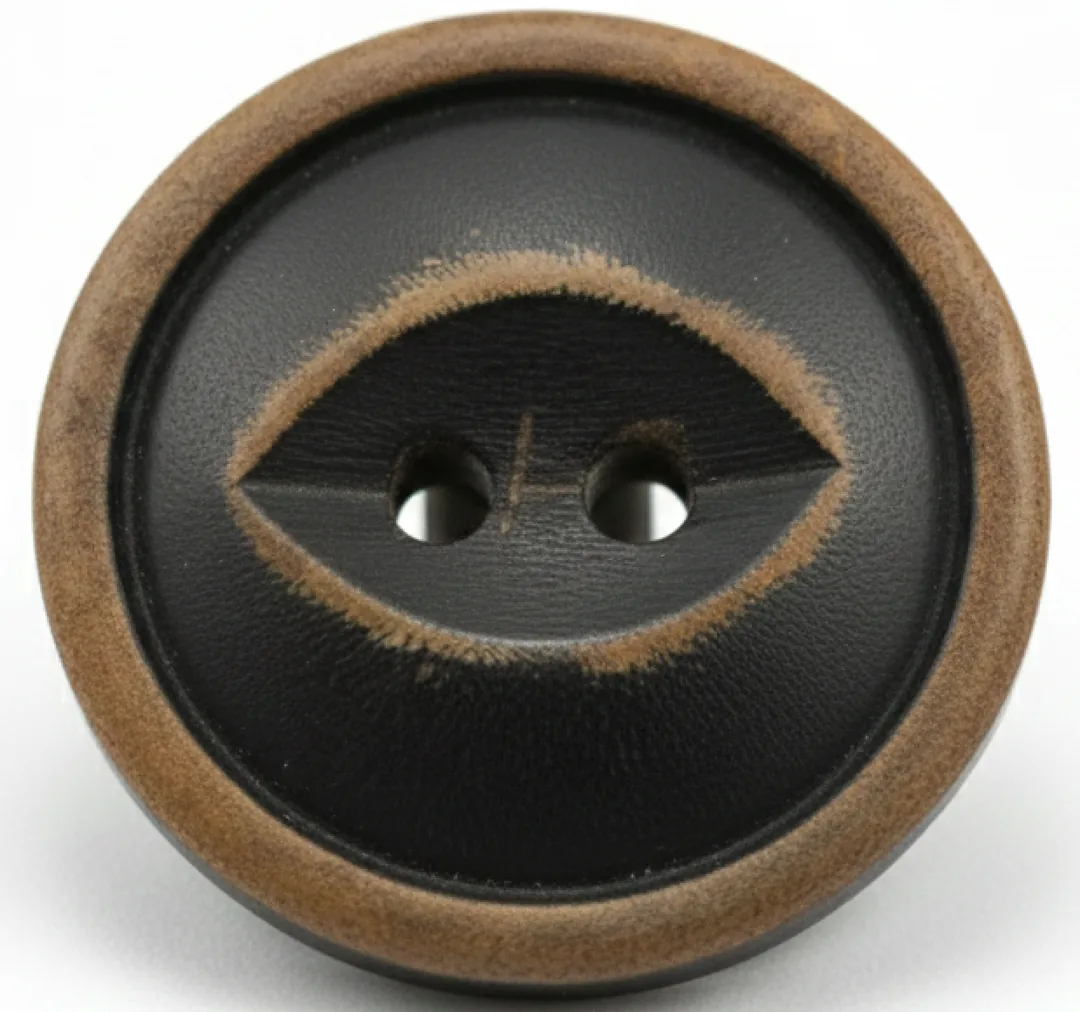
- Holes
- 2H / 4H
- Size
- 24L · 15.2 mm
- Finish
- Amber polished
- MOQ
- 1,000 pcs
- From
- $0.062 / 5k
02 The case for horn
The only button with depth.
Amber horn is translucent: light goes in at the rim and comes back out warmer. No moulded material reproduces that, which is why every faux-horn resin is an attempt rather than a match. It is also a by-product — the horn is a waste stream from an animal already in the food chain.
Nothing was killed for the button
Buffalo horn is collected from animals processed for meat. It is a waste stream we turn into a durable part, not a material grown or synthesised for the purpose.
Light through the rim
Amber and tortoise horn are translucent. A polished rim catches light and holds it, so the button reads warm rather than flat — the single thing the eye picks up at three metres.
The limit, stated plainly
Horn softens above 80 °C. It cannot be boiled, it cannot go through industrial laundering, and it should not sit in a hot dryer. Dry-clean or cold hand wash only.
03 Applications
Where horn is worth the money.
Not a volume material. It belongs on garments where the buyer is already paying for a detail, and where the care label already says dry-clean.
Tailoring & suits
The classic. Black horn on a navy suit reads as depth rather than as a black dot — which is exactly what a resin button cannot do.
Overcoats
Big discs from the thickest part of the horn. Tortoise on camel wool is the combination buyers photograph.
Knitwear & cardigans
Amber against natural wool. The translucency warms up under light in a way that reads as expensive without a logo.
Premium shirting
Only on shirts that are dry-clean or hand wash. A horn button in a weekly 40 °C machine wash will dull and can delaminate.
Leather goods
Belt loops, bag closures, jacket tabs. Horn against vegetable-tanned leather ages in the same direction, which plastic does not.
04 Finishes
Amber, black, tortoise — and what polish does to them.
Horn colour is not applied, it is selected. We sort the raw horn into colour lots before turning, so a black order is black horn, not dyed horn. Adders are at 24L / 5,000 pcs.
Amber polished
Translucent honey to brown. The natural colour of the material.
baseBlack polished
Solid black horn, sorted before turning. Tailoring standard.
+10%Deep brown
Opaque chocolate. Reads warmer than black on navy and grey.
+6%Tortoise
Layered amber and black — the most striking and the scarcest.
+18%Mirror polish
Buff to a glass finish. Catches light, shows handling.
+12%Matte / sanded
Sanded back to a soft sheen. Modern, less formal.
+4%05 Size & shape
Ligne, from 18 to 40.
Horn is turned, not moulded, so the diameter is cut to order within a tolerance. The big sizes come from the outside wall of the horn, which is why a 40L costs roughly three times a 20L rather than two.
06 Process
Sorted, turned, buffed — five steps, four of them by hand.
Horn cannot be moulded, so the whole product is a turning operation. That is why the colour is chosen before the button exists, and why the lead time is two days longer than resin.
Sort the raw horn
Solid black, amber, tortoise and brown are separated at intake. This is the step that decides the finish — you cannot turn a black button out of amber horn.
Soak & slice
Horn is softened in warm water and sliced into plates. Dry horn cracks under the blade; soaked horn cuts clean.
Turn
CNC turning sets diameter, thickness and rim radius. The grain direction is chosen so the face pattern runs the way it was specced.
Drill & buff
Holes drilled from the face down. Then three buffing stages — coarse, medium, mirror — with a rest between so the surface does not burn.
Sort & pack
Hand-sorted by tone within the colour lot. AQL 2.5 visual, packed by colour and garment position.
Where horn fails
Heat, alkali and prolonged soaking. No industrial laundering, no bleach, no tumble dryer. If the care label says 60 °C, this is the wrong button and we will tell you before you order.
A by-product, documented
Horn is collected from animals processed for meat. We can supply a by-product declaration if your compliance team needs one.
Turning from $150
Standard shapes free. A custom profile is $150 and seven days — it is a lathe programme, not a mould.
07 Before you commit
Horn has to be seen in the hand.
The translucency that sells it does not photograph. Put one against a window and the whole material makes sense in about two seconds.
08 How to order
Choose the colour lot, approve the tone.
Horn is the one material where approving a photo is genuinely useless. We send physical buttons for every order above 10,000 pcs, and we expect you to hold them.
Choose colour and size
Amber, black, brown or tortoise, in Ligne. Tortoise has the longest lead time because the raw material is the scarcest.
Approve the tone
Five buttons from the lot, couriered. Hold them against the garment, then against a window.
Sample in 6 days
Eight buttons across two finishes. Test the polish with a fingernail — it should not mark.
Bulk & inspection
8–10 days at 5,000 pcs. AQL 2.5 with photo report, hand-sorted by tone, packed by colour.
Estimate
- Buffalo horn, by-product sourced
- Three-stage hand buffing
- AQL 2.5 inspection with photo report
- Polybag, carton, labelled to your barcode
Indicative only — final price depends on drawing, tooling and packing. All six materials here.
09 FAQ
What buyers ask about horn.
Horn has one hard limitation and several soft ones. Both are here, because a returned shipment is worse than a lost order.
Is an animal killed for these buttons?+
No. The horn is a by-product of animals processed for meat, collected and sold on as a waste stream. We can supply a by-product declaration. If your brand requires a vegan material, corozo or coconut is the answer.
Can it be machine washed?+
No. Horn softens above 80 °C and will deform; it also delaminates if soaked for long periods. Dry-clean, or cold hand wash and dry flat. If the garment needs a 60 °C wash, use resin or corozo.
Why is every button different?+
Because it comes from a different animal, at a different age, with a different diet. Even within one colour lot the tone and grain vary. We sort into tone bands, but we cannot make them identical — and identical horn would be plastic.
How is tortoise made?+
It is not made. Tortoise is the natural layered structure where amber and black horn meet in the same piece. It is the scarcest of the four colours, which is why it carries the highest adder and the longest lead time.
Does the polish wear off?+
It wears in, not off. Horn polishes itself with handling — the surface gets smoother over years, which is the opposite of a lacquered finish. If it looks dry, a drop of mineral oil restores it.
Will it crack at the holes?+
Not if the hole is 1.5 mm from the rim and drilled from the face down. Cracking comes from dry horn being drilled too fast; we soak before slicing and drill at low speed.
Minimum order?+
1,000 pcs per size and finish. Tortoise needs 2,000 because of raw material scarcity, and above 32L the minimum rises to 2,000 in every colour.
Lead time?+
8–10 working days at 5,000 pcs, 11–13 for tortoise or above 32L. Samples in 6 days including the courier.
Send the garment.
We send five buttons from the lot.
Colour, size in Ligne, and the care label. If the label says 60 °C, we will tell you to use a different material.
Reply within 4 working hours · Ningbo, China · Factory-direct since 1996
— total
Reply within 4 h · MOQ 1,000 pcs · Ningbo, China