Material file 02/06 ABS · electroplated plastic
Metal finish, a third of the weightand a third of the price.
Hoodies, kids' wear, casual jackets, caps. 12–25 mm plated ABS that reads brass or silver at three metres and weighs nothing — which is exactly what a lightweight garment needs. The honest caveat: it is a coating, not a metal, and we will tell you where not to use it.
MOQ 1,000 pcs62% lighter than zinc4B adhesionNickel-free option
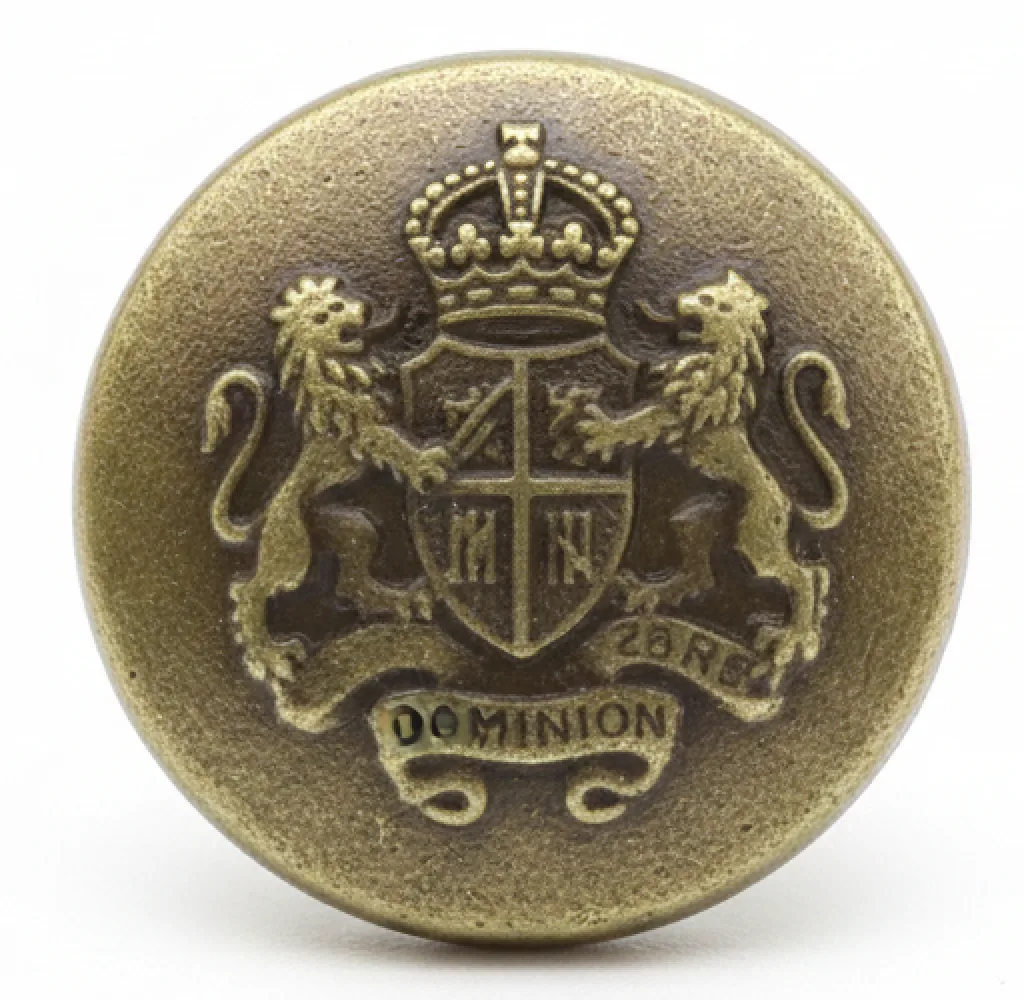
- Holes
- Shank
- Size
- 18 mm
- Finish
- Antique brass
- MOQ
- 1,000 pcs
- From
- $0.019 / 5k
02 The case for plated ABS
Where weight matters more than the metal.
A plated ABS button is not a cheap metal button — it is a different material for a different problem. On a jersey hoodie, ten zinc buttons add 95 g to a garment sold by feel. The same ten in ABS add 36 g, and nobody has yet returned a hoodie because the buttons were not real brass.
Weight, against die-cast zinc
An 18 mm zinc button weighs about 9.5 g; the same size in plated ABS is 3.6 g. On a ten-button garment that is 59 g you do not have to ship, and a hoodie that does not hang forward.
Half the landed cost
At 5,000 pcs an 18 mm plated ABS is $0.019 against $0.048 in zinc. On a 30,000-piece run that difference is a marketing budget — or a margin you keep.
Adhesion, and where it fails
Plating on plastic is a coating. It passes 4B cross-hatch and 24 h salt spray, but it will not survive a metal file. Put it on the front placket, not on a corner that rubs a bag strap every day.
03 Applications
Where plated ABS is the right call.
If the garment is washed at home, worn against skin, and sold on hand-feel rather than weight, ABS is usually the better engineering choice — not the compromise.
Hoodies & sweatshirts
Drawcord hardware and eyelets in the same plating so the trims match. Light enough that the placket does not pull open when the garment hangs.
Shirting & polos
Thin rim and a low dome — nothing to press around. Pearl and off-white are the two we ship most; plated silver reads too dressy under a collar.
Casual jackets
The big-volume use. Gunmetal hides the micro-scratches that bright silver shows after a season of wear.
Lightweight coats
Rimmed edge gives the visual weight of a metal button without the 190 g. Use it where the coat is already heavy enough without help.
Kids' & baby wear
No nickel in the bath, no sharp edge on the underside. The lightest option we make that still passes a pull test above 50 N.
04 Finishes
Seven platings on one mould.
Same plating line as our metal buttons, thinner deposit. Adders are at 18 mm / 5,000 pcs and scale with the button, because a larger face takes longer in the bath.
Bright silver
The volume finish. Reads chrome from a metre away.
baseBright gold
Warm gold flash. Popular on school and club uniforms.
+15%Gunmetal
Dark, cool, forgiving of scratches. Outerwear default.
+8%Antique bronze
Darkened relief so the rim reads. Casual jackets, bags.
+8%Pearl white
Not plated — a pearlescent lacquer. Shirting and kidswear.
+12%Translucent / ice
Tinted clear over plating. Reads as glass, wears as plastic.
+10%Painted solid
Any Pantone, matte or gloss. Cheapest way to hit a brand colour.
+5%05 Size & shape
Millimetres, with the Ligne in brackets.
Same diameters as our metal range, so a garment can switch from zinc to ABS without redrawing the placket. Tolerance is looser — ±0.1 mm against ±0.05 mm — and that is reflected in the price.
06 Process
Moulded, plated, checked — in six days.
ABS is faster than metal because there is no die casting and no polishing between casting and plating. It is also less forgiving: a mould flaw shows straight through the plating, so the first-off check matters more, not less.
Mould
ABS pellets, injected at 230 °C. Wall thickness is set to 1.8–2.8 mm — thin enough to stay light, thick enough to hold the shank.
Degrease & etch
The step that decides whether plating sticks. A chrome-sulphuric etch creates the mechanical key; skip it and the coating lifts at the rim within a season.
Plate
Copper strike, then nickel, then the top coat. Rack-plated so the visible face gets a full deposit.
Lacquer & bake
Clear or tinted lacquer over the plating, cured at 120 °C. This is what stops tarnish in the carton.
Test & pack
Cross-hatch, 24 h salt spray, pull test. AQL 2.5 visual. Packed by colour and garment position.
We will talk you out of it
If the button sits where it rubs — a bag strap, a seat belt, a cuff — we say so and quote zinc instead. A returned garment costs more than the 3¢ difference.
Same plating line, thinner layer
ABS and metal are plated in the same building, so a mixed order comes out the same colour. That is not true of most suppliers.
Tooling from $90
ABS moulds are cheaper than dies. Half credited back at 50,000 pcs.
07 Before you commit
Judge the coating, not the photo.
Every plated-ABS complaint we have seen started with a buyer who never scratched the sample. Do it before the PO, not after.
08 How to order
Send a reference, get a plated sample.
No die on a standard shape — we hold 40 moulds. That is what makes ABS fast: a standard 18 mm 4-hole can be at your desk in six days.
Pick a mould or draw one
Forty standard shapes are free to use. Custom costs from $90 and five extra days.
Set the plating
Send a reference button or a Pantone for painted. We plate a coupon against it.
Sample in 6 days
Six buttons, photographed against grey. Scratch one — that is the point of the sample.
Bulk & inspection
6–8 days at 5,000 pcs. AQL 2.5 with photo report, packed by colour.
Estimate
- Copper strike + nickel + lacquer
- Nickel-free bath on request
- AQL 2.5 inspection with photo report
- Polybag, carton, labelled to your barcode
Indicative only — final price depends on drawing, tooling and packing. All six materials here.
09 FAQ
What buyers ask about plated ABS.
Straight answers, including the ones that lose us the order.
Will the plating peel?+
Not if it is etched properly. Peeling starts at the rim, where a bad etch leaves no mechanical key. We cross-hatch every lot to 4B and reject below that. What we cannot promise is a coating that survives being rubbed against a metal zip for a year — no plated button does.
Can you tell it is plastic?+
At 30 cm, yes — the weight gives it away before the eye does. At the distance a garment is actually judged (on a hanger, in a shop, in a photo), no. If the buyer picks the button up and expects brass, use zinc.
Is it dishwasher or industrial-wash safe?+
Domestic 60 °C, ten cycles, grade 4 — yes. Industrial laundering at 75 °C with bleach — no. The lacquer goes first, then the nickel. For workwear, specify zinc.
Nickel-free?+
Yes, palladium over copper. Same 0.5 µg/cm²/week release limit as metal, tested to EN 1811. It costs about 12% more and needs to be on the PO.
What is the real saving against zinc?+
At 18 mm / 5,000 pcs: $0.019 vs $0.048, so 60% less per button. Freight also drops because the carton is lighter. On a 30,000-piece order with eight buttons each, the difference is about $6,900.
Why is the tolerance ±0.1 mm?+
Injection moulding shrinks as it cools, and the shrink varies with wall thickness. ±0.1 mm is honest for this process. If your placket needs ±0.05 mm, that is a metal button or a resin button, not ABS.
Minimum order?+
1,000 pcs per size and finish on a standard mould, 3,000 on a custom one. Mixed finishes on the same mould are fine above 500 pcs each.
Lead time?+
6–8 working days at 5,000 pcs on a standard mould, plus 5 days if the mould is new. Samples in 6 days including plating.
Send a reference button.
We plate a coupon against it.
Size, finish, quantity, and where the button sits on the garment. That last one usually decides whether we quote ABS or zinc.
Reply within 4 working hours · Ningbo, China · Factory-direct since 1996
— total
Reply within 4 h · MOQ 1,000 pcs · Ningbo, China