
Material file 04/06 Tagua palm nut · vegetable ivory
Corozo was the right colourbefore we touched it.
Tailoring, shirts, chinos, knitwear. 16L–40L, cut and polished from tagua palm, natural or dyed, engraved on the face. It takes a hot iron and a dry-clean better than any plastic — and unlike a faux-horn resin, it does not pretend to be anything.
MOQ 1,000 pcs100% plant-basedDry-clean safeFree tech-pack review
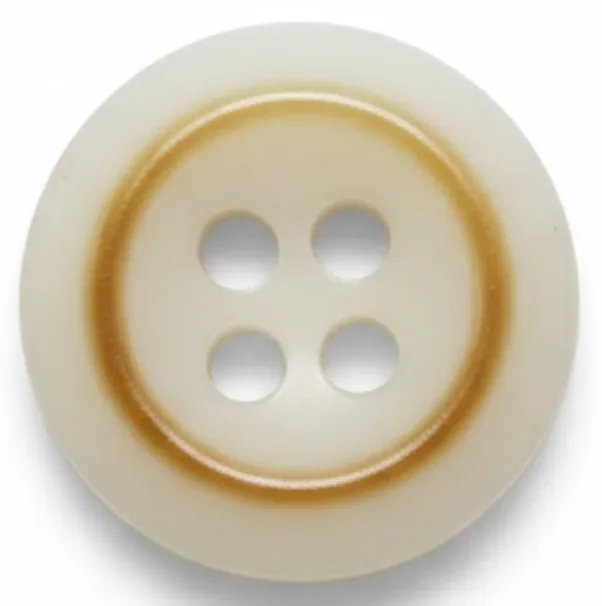
- Holes
- 4H
- Size
- 20L · 12.7 mm
- Finish
- Natural
- MOQ
- 1,000 pcs
- From
- $0.042 / 5k
02 The case for corozo
A button that came out of a plant, not a reactor.
Tagua is the seed of a South American palm. It is hard, it polishes like ivory, and it is the only button material that a sustainability auditor will accept without a footnote. It also has real limits — which we list further down rather than leave you to discover.
Plant-based, no coating
No polymer, no plating, no lacquer. The colour is dyed into the fibre and the surface is polished nut, so there is nothing to flake off. Biodegradable under industrial composting.
Abrasion life against resin
Tagua is denser than PBT. On a cuff or a placket edge, where resin buttons round off and go dull, corozo holds its rim and stays bright in the polish.
Colour, with the caveat stated
Dyed batches hold ΔE 1.5 against your chip. Natural, undyed corozo varies from cream to pale caramel between seeds — that variation is the material, and we do not sort it out.
03 Applications
Where corozo is the sensible spec.
It is the default button on European tailored clothing for a reason: it irons, it dry-cleans, and it does not read as plastic under a shop light.
Tailoring & blazers
The classic. A 28L natural corozo on a navy blazer is what a buyer expects to find — anything else reads as a cost cut.
Shirting
Thin 1.8 mm discs so the placket stays flat under a collar stand. Bleached runs whiter than natural and takes a hot iron without scorching.
Chinos & casual trousers
Waistband buttons get dyed dark so a rub against a belt does not show. Rimmed edge for the extra thickness.
Knitwear & cardigans
Natural corozo against wool is the warmest combination on the page. Smooth rim so it does not catch a 7gg knit.
Coats & overcoats
Big discs are cut from the thickest part of the seed, so above 36L the yield drops and the price climbs. Worth it on a wool coat.
04 Finishes
Dyed, bleached or left alone.
Corozo finishes are colour and surface, not coating. Adders are at 20L / 5,000 pcs; dye cost is per batch, so bigger buttons carry it more cheaply than small ones.
Natural
Unbleached, polished. Cream to pale caramel, varies by seed.
baseBleached
Peroxide-bleached to an even off-white. Shirting standard.
+8%Dyed black
Deep, even, holds through dry-cleaning. Waistbands and formal.
+12%Dyed navy
The tailoring default after black. Runs slightly warm, not blue-black.
+12%Dyed burgundy
Seasonal colour. Batch minimum 3,000 pcs.
+14%Laser engraved
Your mark or a stitch-line, burned into the face. 0.3 mm deep.
+20%05 Size & shape
Ligne, with the millimetre beside it.
Corozo is cut from a seed, so the top of the range is limited by how big the nut grows. Above 36L the yield falls off and the price moves accordingly — we quote both size and yield honestly.
06 Process
Sliced, turned, polished — five steps with the seed visible in all of them.
Corozo is not moulded, so the process is closer to a small joinery than a plastics line. That is also why the colour and the grain are real.
Sourcing
Tagua nuts from Ecuador and Colombia, dried 8–12 weeks until the interior hardens to an ivory density. Wet nuts crack in the lathe.
Slicing
The nut is cut into discs on a multi-blade saw. Thickness is set here; a 1.8 mm shirt disc and a 3.4 mm coat disc come off the same block.
Turning & drilling
CNC turning sets the diameter and the rim radius; holes are drilled after turning so the face does not chip at the exit.
Dye or bleach
Vacuum dyeing for colour, peroxide for white. Dyed lots rest 48 h before the colour is read — corozo keeps darkening for a day.
Polish & QC
Barrel polish to the required sheen, ΔE check against the approved chip, then AQL 2.5 visual and a hole-clearance gauge.
Where corozo loses
It absorbs water: leave it soaking and the disc swells 3–5%. It also scorches above 180 °C. Both are fine for tailoring, both are wrong for beachwear.
Traceable to the co-op
Our tagua comes through two cooperatives with collection records. If a sustainability audit asks where the button came from, we can answer with a document.
Tooling from $120
Standard shapes are free. A custom engraved face needs a laser file, not a mould — $120, five days.
07 Before you commit
Corozo is a material you have to hold.
A photograph makes it look like plastic. In the hand it is cold, dense and slightly waxy — that is the whole point, and it does not survive a screen.
08 How to order
Pick a colour, approve the chip.
The one thing that catches buyers out is the gap between a natural and a dyed lot. Approve a physical chip, not a screen colour, and the rest is routine.
Choose natural or dyed
Natural needs no minimum colour run. Dyed needs 3,000 pcs per colour, and burgundy or green need 5,000.
Approve the chip
We send three buttons from the dye lot. Approve against daylight and against your fabric — not against the monitor.
Sample in 6 days
Six buttons plus the chip, couriered. Iron one at 150 °C; it should not mark.
Bulk & inspection
6–8 days at 5,000 pcs. AQL 2.5 with photo report, packed by colour.
Estimate
- Tagua palm nut, traceable to co-op
- Vacuum dyeing, ΔE 1.5 held per lot
- AQL 2.5 inspection with photo report
- Polybag, carton, labelled to your barcode
Indicative only — final price depends on drawing, tooling and packing. All six materials here.
09 FAQ
What buyers ask about corozo.
Including the two answers that make some buyers choose resin instead — which is fine, as long as it is a decision and not a surprise.
How is it different from faux-horn resin?+
Resin is moulded and printed to look like horn. Corozo is a plant seed that already has the grain; nothing is printed. Hold both: corozo is colder, denser, and the grain goes through the disc, not across the surface.
Can it go in a washing machine?+
Yes, at 40 °C, but it will dull over repeated washes and it takes up water. For shirting that gets washed weekly, we recommend resin. For tailoring that gets dry-cleaned, corozo is the better material.
Does it scorch when ironed?+
Not below 160 °C. Above 180 °C the surface marks. Use a press cloth as you would on wool — that is the whole instruction.
Why does the natural colour vary?+
Because it is a seed, not a batch of pigment. Natural corozo runs from cream to pale caramel, and the grain varies. If your buyer needs an even colour, choose bleached or dyed — that is what those two finishes are for.
Is it really biodegradable?+
Yes — it is cellulose, and it breaks down in industrial composting. We can supply the material declaration, but we do not claim home-compostable, because a lacquered or dyed disc is slower than a raw one.
Any certification?+
The tagua supply chain is traceable to two cooperatives; we can supply collection records and a material declaration. We do not hold FSC or GOTS for buttons — ask us for what actually exists rather than a logo.
Minimum order?+
1,000 pcs for natural, 3,000 pcs per colour for dyed, 5,000 for seasonal colours like burgundy or green.
Lead time?+
6–8 working days at 5,000 pcs in a stock colour, 9–11 days for a new dye lot. Samples in 6 days including the courier.
Send the colour and the size.
We send three buttons from the dye lot.
Natural or dyed, size in Ligne, and what the garment gets: dry-clean, hand wash, or a hot iron.
Reply within 4 working hours · Ningbo, China · Factory-direct since 1996
— total
Reply within 4 h · MOQ 1,000 pcs · Ningbo, China